UT Austin researchers use light-controlled 3D printing to produce lifelike anatomical models from one resin
A new approach to multi-property printing
Researchers at The University of Texas at Austin have demonstrated a 3D-printing method that can produce anatomical replicas with regions that feel markedly different—rigid where bone would be and softer where tissue, ligaments, or tendons would be expected—without switching materials during fabrication. The process is designed to work on common, low-cost resin printers and relies on controlling light exposure to tune material properties within a single printed object.
The technique, known as Crystallinity Regulation in Additive Fabrication of Thermoplastics (CRAFT), uses projected grayscale light patterns during printing. By varying light intensity across each layer, the method changes the internal molecular order of the solidifying plastic. That shift in microscopic structure translates into macroscopic differences in stiffness and optical clarity across the same part.
How CRAFT changes hardness and transparency
In conventional resin printing, material properties are largely set by the chemistry of the resin, and multi-property models often require multiple materials printed together or assembled afterward. CRAFT instead uses one feedstock and adjusts the resulting properties by regulating crystallinity as the part forms. In practice, the same print can include flexible sections alongside rigid internal features, with transitions defined by the projected grayscale “blueprint.”
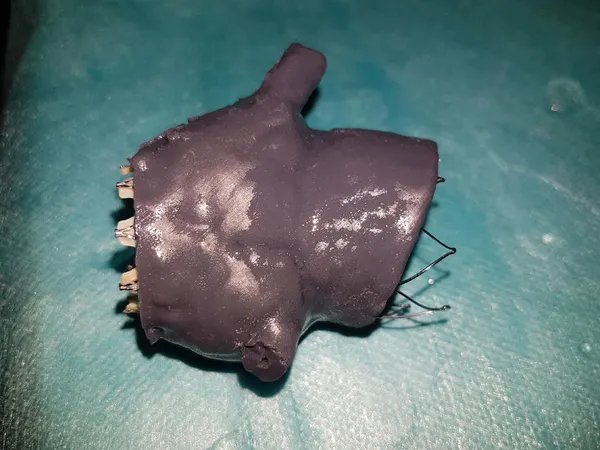
In UT Austin demonstrations, the approach produced small anatomical structures, including a finger model printed in about 25 minutes that contained softer outer regions and a rigid internal core intended to mimic bone. The printed models also incorporated variations in opacity and transparency, enabling internal features to be seen or concealed depending on the design.
Why the seam problem matters for training models
Medical training models are increasingly used for surgical practice and procedure planning, but multi-material prints and assembled parts can create seams where different materials join. Those interfaces can alter mechanical behavior, potentially reducing realism in how a model responds to cutting, suturing, or applied force. Because CRAFT generates differing properties from a single resin, it can reduce or eliminate material interfaces that would otherwise be weak points.
- Single-resin fabrication with localized control over stiffness
- Pixel-level tuning through grayscale light patterns
- Potential to produce models with bone-like cores and tissue-like outer regions
- Compatibility with widely available digital light processing (DLP) or LCD-style printers
Cost, scalability, and sustainability considerations
The research team has emphasized accessibility, demonstrating compatibility with commercial printers that can be acquired for around $1,000 or less and using a widely available resin. Current outputs highlighted by the lab are small parts—fingers, joints, and sections of hands—but the approach is presented as scalable to larger, more complex structures.
The central capability is spatial control of a material’s mechanical and optical properties using light intensity during printing.
Beyond medical training, the same ability to engineer hard-soft internal architectures is being explored for energy-damping applications, including protective equipment. The printed parts are not described as fully recyclable, but the material can be reprocessed by melting or dissolving and recasting, which could reduce waste compared with typical printed thermosets. The findings were published in the journal Science in early 2026.