UT Austin-Led Team Identifies Doolysaurus huhmini, a New Small Dinosaur Species From South Korea
A newly named dinosaur adds rare body-fossil evidence to South Korea’s Cretaceous record
Researchers including a University of Texas at Austin scientist have formally described a new dinosaur species from South Korea, based on a partial skeleton that includes diagnostic skull material—an uncommon type of evidence in the country’s dinosaur record, which has more often been represented by eggs and footprints than by well-preserved body fossils.
The dinosaur, named Doolysaurus huhmini, is a small ornithischian and has been classified within Thescelosauridae, a group of generally small-bodied, primarily plant-eating dinosaurs. The formal description places the animal among early-diverging neornithischians, a broad branch of bird-hipped dinosaurs that helps frame how smaller ornithischians diversified during the Cretaceous.
Where the fossil was found and what was preserved
The fossil was discovered in 2023 in exposures of the Ilseongsan Formation on Aphae Island (Shinan County), off the southwestern coast of the Korean Peninsula. The specimen is curated at the Korea Dinosaur Research Center at Chonnam National University under the catalog number KDRC-SA-V001.
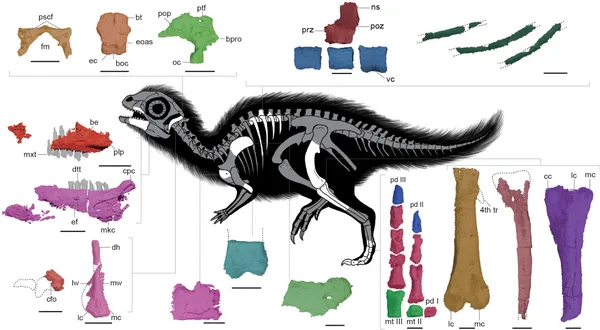
Although incomplete, the skeleton is reported as three-dimensionally preserved and includes parts of the skull, sections of the vertebral column, and elements of both the forelimb and hindlimb. The authors interpret the individual as a juvenile based on multiple anatomical and tissue-level indicators, including incomplete fusion of cranial elements and evidence from bone microstructure.
Size estimates and diet-related clues
Using measurements related to femoral circumference, the research team estimated the animal’s body mass at roughly 8.3 kilograms (about 18 pounds), underscoring its relatively small size compared with many better-known Cretaceous dinosaurs.
The specimen was also found with an associated set of 40 to 50 gastroliths (stones swallowed to aid digestion). The stones’ combined mass was reported at about 30.7 grams, and the study discusses their shape and quantity as information relevant to interpreting feeding ecology in small-bodied dinosaurs.
Why this find matters for Korean paleontology
Doolysaurus is notable as the first named dinosaur from South Korea described with diagnostic cranial material, strengthening the anatomical basis for identifying and comparing Korean dinosaur body fossils. It is also described as the second named basal neornithischian from the country, adding another reference point for placing Korean fossils into broader evolutionary trees.
By providing skull material suitable for diagnosis, the new specimen improves the resolution of comparisons across early-diverging neornithischians and helps reduce reliance on trackways and eggs alone when reconstructing local dinosaur diversity.
Key facts at a glance
- Species name: Doolysaurus huhmini
- Geologic age: mid-Cretaceous (Albian–Cenomanian), approximately 113–97 million years ago
- Locality: Ilseongsan Formation, Aphae Island (Shinan), South Korea
- Material: partial skeleton including diagnostic skull elements
- Estimated mass: about 8.3 kg (18 lb)
The study positions the new species as evidence that South Korea’s Cretaceous formations can yield informative body fossils capable of refining evolutionary and ecological interpretations, complementing the region’s globally known footprint and egg sites.