Starlink satellite “train” sighting over North Austin highlights how new launches look from the ground
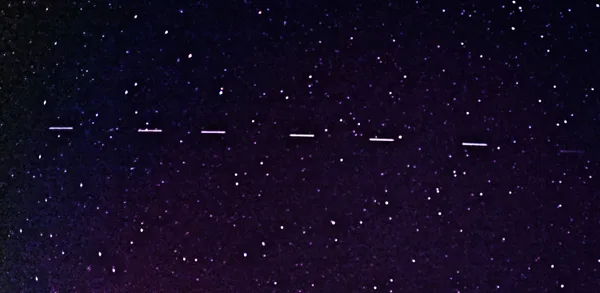
What residents reported seeing
North Austin residents reported a line of evenly spaced lights moving steadily across the night sky—an appearance commonly associated with newly deployed Starlink satellites soon after launch. The phenomenon is often described as a “satellite train,” when multiple spacecraft follow one another along the same orbital path and can be visible to the naked eye under clear conditions.
Why Starlink satellites can look like a string of lights
Starlink satellites are placed into low Earth orbit and, in the period immediately after deployment, travel in a tight formation before gradually spreading out as they maneuver to their assigned positions. During that early phase, the satellites can reflect sunlight toward observers on the ground, making them appear as a moving row of bright points.
Visibility is most likely around dusk or dawn, when the ground is dark but the satellites remain illuminated by the Sun. Individual satellites typically resemble fast-moving stars and do not blink like aircraft navigation lights.
Recent launches that can create visible “trains”
SpaceX has continued frequent Starlink launches in early 2026, including missions on January 4, January 12, and January 14, 2026, each deploying batches of satellites into low Earth orbit. Sightings over Texas in the days that follow a launch are possible because the satellites complete an orbit roughly every 90 minutes, and one or more passes may be visible from the Austin area depending on timing, altitude, and lighting conditions.
How to distinguish Starlink from other common sky sightings
Airplanes: typically show red/green navigation lights and may blink; their motion can include changes in direction consistent with air traffic patterns.
Meteors: usually appear as a brief streak lasting seconds, not a long procession of separate points moving together.
The International Space Station: can be very bright but appears as a single object, not a line of multiple lights.
What to do if you want to confirm a sighting
Residents looking to verify whether a line of lights is Starlink can use satellite-tracking tools that provide pass predictions by location and time. For the most reliable match, observers should note the exact time of the sighting, direction of travel, and how long the lights remained visible before fading—details that can be compared with predicted satellite passes.
Starlink “trains” are typically most noticeable shortly after launch and become less visually prominent as satellites spread into wider spacing.
The North Austin reports fit a pattern seen in many U.S. cities: a brief, orderly procession across the sky that draws attention precisely because it differs from the single-point motion of most satellites.