Great Blue Herons Are Nesting Near Downtown Austin, Drawing Attention to an Urban Rookery
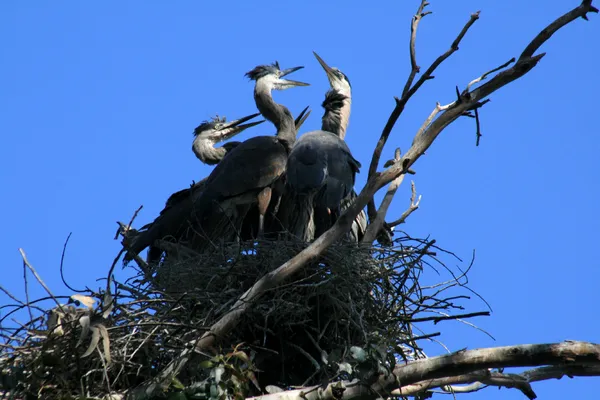
A colony in the city’s core
A breeding colony of great blue herons has become active near Downtown Austin, placing a large, highly visible waterbird in close proximity to dense development and one of the city’s busiest outdoor recreation corridors. Great blue herons are among the most widespread herons in Texas, and they can nest either as isolated pairs or in colonies, sometimes alongside other colonial waterbirds.
In Central Texas, the species’ breeding season extends across much of the year. In Texas broadly, breeding has been documented from late January through late August, with eggs typically recorded from late February into mid-June and nestlings present from late March into late July. That timeline makes late winter and spring a key period for activity at active nesting sites.
Why nesting colonies form where people can see them
Great blue herons depend on water-associated habitats for feeding, but they are adaptable and use a wide variety of landscapes, including reservoirs, riverbanks, ponds, and riparian woodlands. Nesting sites are variable as well, most commonly in trees but also in shrubs and, in some settings, on artificial structures. Colonies are generally associated with areas that provide some buffer from repeated disturbance, even when those areas sit within a heavily used urban environment.
Lady Bird Lake, a reservoir on the Colorado River in downtown Austin, concentrates shoreline habitat and foraging opportunities within a short distance of trees and vegetated edges. The setting also concentrates people: the Ann and Roy Butler Hike-and-Bike Trail at Lady Bird Lake is a 10-mile loop that attracts millions of visits per year, increasing the likelihood that nesting behavior will be noticed and photographed.
Legal protections and what “disturbance” can mean
Herons are migratory birds protected under federal law, including protections that extend to nests, eggs, and young birds that are still dependent on the nest. Under those rules, destroying an active nest or interfering with it can be unlawful, and permits are generally limited to narrow circumstances tied to safety or urgent risk.
- Active nests should be given space, particularly during the period when eggs or chicks may be present.
- Approaching closely enough to cause adults to flush repeatedly can increase stress and expose eggs or chicks to weather and predators.
- Tree work near active nests can carry legal risk and can also result in nest failure if it triggers abandonment.
What the rookery signals about Austin’s urban ecology
In Texas, great blue herons are considered abundant and widespread, and their continued use of urban waterways underscores how riparian corridors can function as habitat even as surrounding land uses intensify. At the same time, a rookery near Downtown Austin highlights the practical tension between wildlife needs and high-foot-traffic parks: colonies can be noisy, and droppings can affect nearby walkways, parked vehicles, and structures when nests are clustered over public space.
When a rookery forms in a central city location, it becomes both a natural spectacle and a management challenge: visible enough to educate the public, but close enough to everyday activity that minimizing disturbance matters.
As the nesting season progresses, the colony’s visibility is likely to rise as adults shuttle between nests and feeding areas and as chicks develop. For residents and visitors, the most consequential variable may be simple: whether people keep enough distance for the birds to complete the breeding cycle successfully.